What is randomization?
Randomization is a systematic process of random assignment. When we say systematic yet random, we mean that the assignments should not be haphazard.
To understand this, take a look at the following examples:
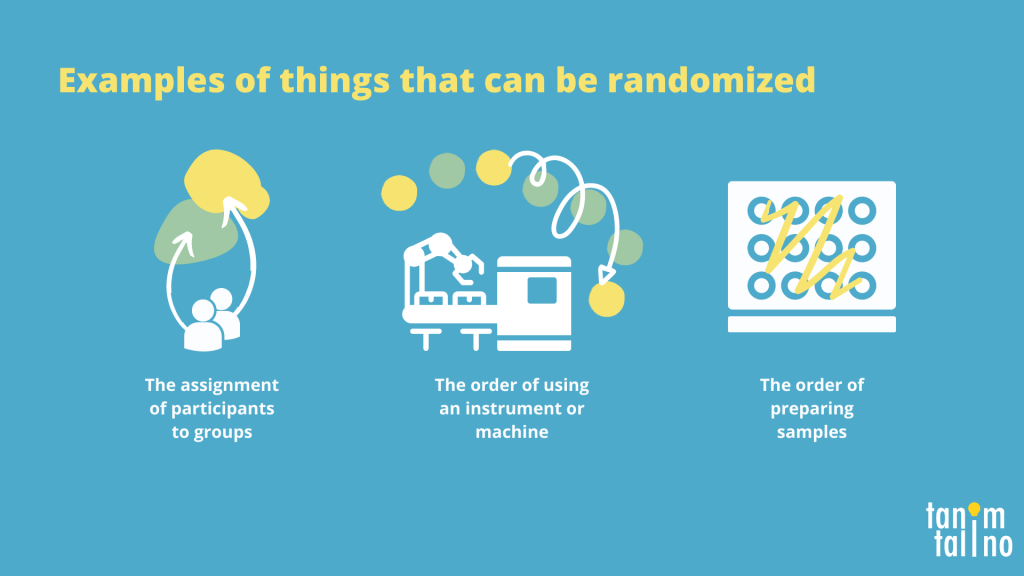
- If there were two drugs (Drug A and Drug B) and two participants (Participant A and Participant B), Drug A should not be immediately assigned to either Participant A or B. The assignments could be decided using a coin flip.
- If there were three treatments (Treatment A, Treatment B, and Treatment C) that needed to be read in an instrument, Treatment A should not immediately be read first, and Treatment C last. The assignments could be decided using a random number generator from a calculator or website.
- If there were ten treatments with three samples each that needed to be developed for 15 minutes, the three Treatment A samples should not be done first, then Treatment B, and so forth. The order of processing the samples could be decided using statistical software.
Everything in bold is an example of a system that gives “random” outcomes. Each is an example of how the randomization of assignments should not be haphazard.
Randomization is done to avoid or reduce “bias” or errors arising from assignments. Take a look at the potential impacts if the examples were not properly randomized:
- Participant A has an unknown natural resistance against Drug A. If Drug A were immediately assigned to Participant A, the conclusion of Drug A’s potency will be incorrect. (Therefore, we also need more participants; two participants are not enough.)
- Because of some limitations of the instrument, the readings fluctuate after 20-30 minutes. If the order of reading the treatments were not randomized, Treatment C (the last read) will have a large error compared to Treatment A (the first read). The statistical analysis would not become as effective.
- If all the samples were read simultaneously but the treatment preparation was not randomized, there is a possibility that the different development times have an impact. All of the treatments would have bias. (If all the samples were processed at the same time, this problem would likely be avoided.)
REMEMBER:
If you have something you need to assign in research, you need to randomize.
Randomization is not haphazard. You need a random system like a coin flip, random number generator, or software.
There is potential bias or error in the data if the experiment were not properly randomized.

